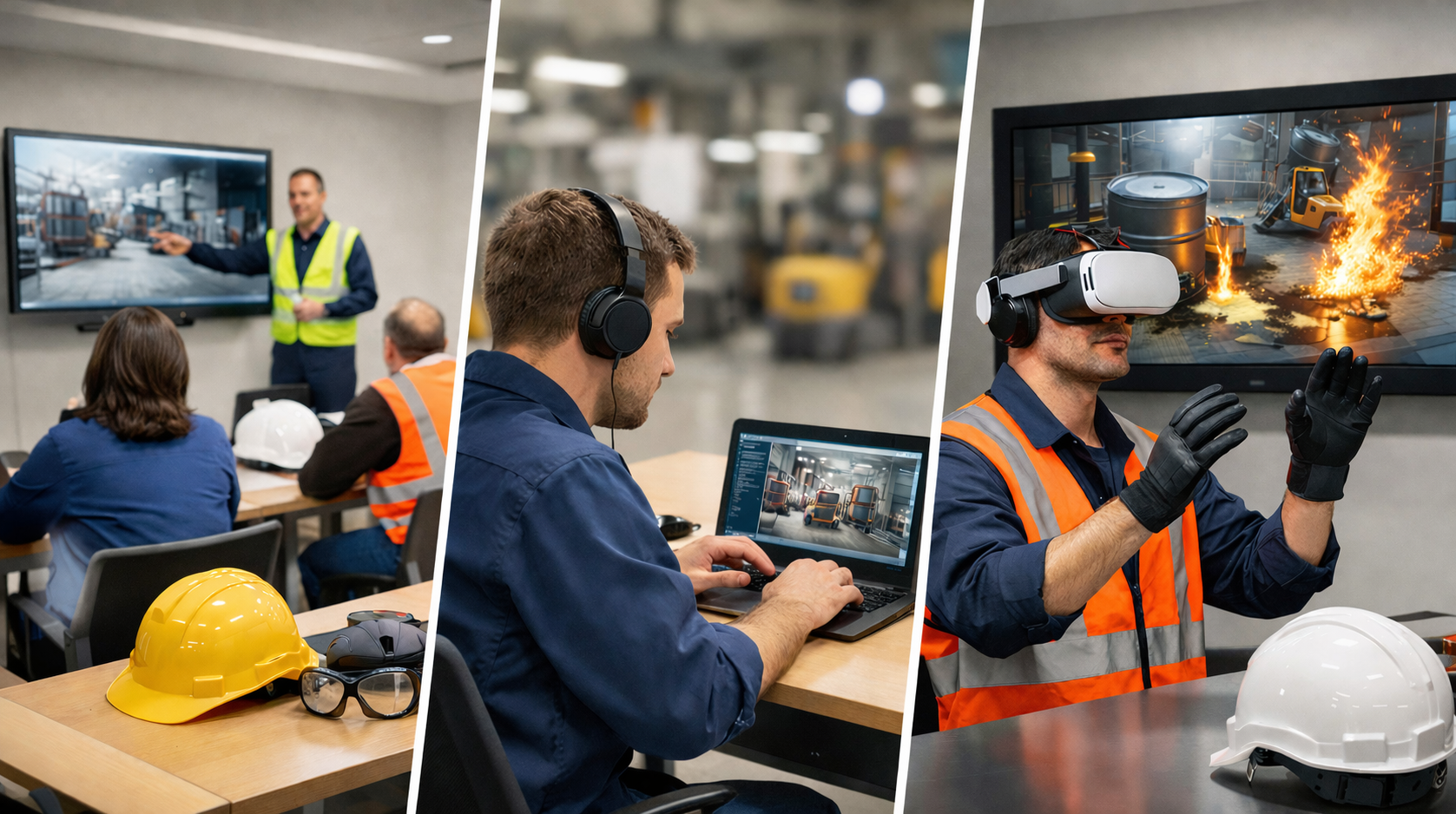
Every year, 3 million workers around the world lose their lives to work-related causes, roughly 6,000 every single day. Behind most of these tragedies lies a common thread: the worker knew the hazard existed, but had not truly internalized how to respond. The question for every EHS professional, then, is not whether safety training matters. It is whether the training format you are using is actually working.
This article offers a straight comparison of four widely used safety training methods: traditional classroom-based instruction, e-learning, VR/AR simulation, and 3D animation to help safety managers make evidence-led decisions based on their workforce, environment, and budget.
1. Traditional Classroom Training
For decades, classroom instruction has been the default format for workplace safety: an instructor, a presentation, printed handouts, and a signed-off register. It offers one genuine advantage: human interaction. Complex policy questions can be answered in real time, and instructors can read the room.
However, the retention data is damning. Research published in Applied Ergonomics found that workers forget up to 50% of classroom-based training content within an hour, and as much as 70% within 24 hours. In high-hazard environments, that rate of decay is not an inconvenience — it is a liability.
Additional drawbacks include:
- Inconsistency across instructors and sites
- No way to simulate live hazards safely
- High recurring cost for refresher sessions
- Difficult to scale across geographically dispersed teams
Best suited for: Policy orientation, team inductions, and scenarios where discussion and Q&A are essential.
2. E-Learning and LMS-Based Training
Digital learning platforms have transformed safety compliance over the past two decades. Organizations can deliver standardized modules at scale, track completion with precision, and localize content across multiple languages.
Retention improves meaningfully over traditional instruction, with estimates ranging from 25% to 40%, and the cost-per-learner drops considerably once content is produced. The accessibility is also a genuine operational advantage: workers can complete modules on shift, on mobile, or at their own pace.
The core limitation is engagement. Static slides and multiple-choice assessments rarely reflect the sensory complexity of a real factory floor or construction site. A worker who has clicked through a confined space module may still hesitate when facing the actual environment for the first time.
Best suited for: Compliance documentation, refresher training, knowledge assessments, and policy updates.
3. VR and AR Simulation
Virtual and augmented reality represent the most immersive end of the safety training spectrum. Workers don a headset and step into a simulated version of their worksite, experiencing a forklift tip-over or a chemical spill without any physical risk.
Retention outcomes are impressive. Studies suggest VR-trained learners retain up to 70–75% of content, driven by full sensory engagement and realistic consequence modelling. For behavioral safety training in particular, working at height, emergency evacuation, and LOTO procedures, the results are compelling.
The constraints are also significant:
- High capital and maintenance costs for headsets and software licences
- Requires dedicated hardware per learner, limiting simultaneous training capacity
- Not easily updated when procedures change
- Can cause motion discomfort in some users, limiting accessibility
Best suited for: High-stakes scenario training in environments with the budget and infrastructure to support it.
4. 3D Safety Animation
Three-dimensional animation sits at the intersection of visual engagement and operational practicality. It renders physical processes hydraulic pressure, arc flash, and gas diffusion exactly as they occur inside machinery, making the invisible visible in a way no photograph or diagram can.
The retention evidence is strong. Applied Ergonomics research found that animation-trained workers retained 83% of information after three days, a 73-percentage-point improvement over text-based instruction. The National Safety Council has linked animated safety training to a 70% reduction in workplace incidents at implementing organizations.
Key operational advantages include:
- Consistent delivery across all sites and shifts with no instructor dependency
- Risk-free depiction of hazardous scenarios — confined space entry, chemical exposure, machinery entrapment
- Cost-effective at scale: a 3–5 minute module typically recovers its production cost within the first two training cycles
- Easily updated as procedures, regulations, or equipment change
The principal limitation is that it is not interactive in the same sense as VR — the learner observes and absorbs rather than physically navigating a scenario. It is also less suited to open-discussion formats where workers need to ask situational questions.
Best suited for: Pre-task briefings, hazard communication, procedure standardization, induction training, and compliance content at scale.
Quick-Reference Comparison
How to Choose the Right Format
No single method is universally optimal. The right format depends on three variables:
- Hazard severity: The higher the risk of fatality or serious injury, the more critical retention becomes. In these environments, formats with evidence of 70%+ retention, such as animation or VR, are the more defensible choice.
- Budget and scalability: For organizations training hundreds or thousands of workers across multiple sites, e-learning and animation offer the most cost-effective way to ensure consistency. VR remains difficult to scale without significant capital investment.
- Training objective: Compliance documentation favors e-learning. Behavioral change and hazard internalization favor animation and VR. Team discussion and policy clarification favor classroom formats.
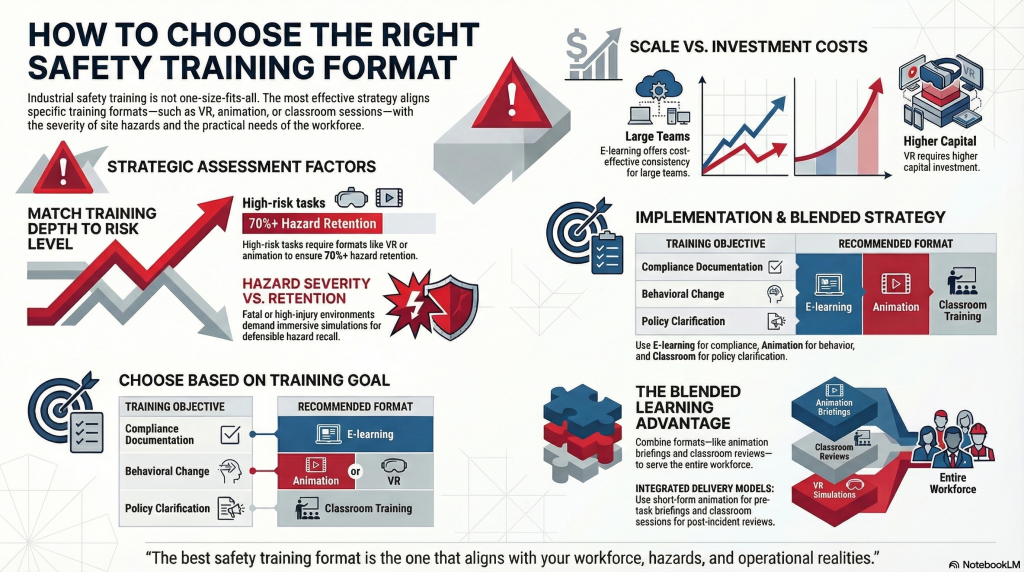
Many leading organizations combine formats: e-learning for compliance records, short-form animation for pre-task briefings, and classroom sessions for post-incident review. The question is not which method wins — it is which combination best serves your workforce and risk profile.
Final Thought
The ILO has set a target of reducing global workplace fatalities by 50% by 2030. Achieving that will require more than policy — it will require training formats that people actually remember under pressure. Whatever combination your organization chooses, the benchmark should be simple: does this format change what a worker does in the moment that matters?