Falls from height continue to claim lives across UK construction sites, with demolition work presenting some of the most dangerous scenarios. HSE statistics consistently show these incidents account for a large proportion of workplace deaths. Demolition sites bring unique challenges where hazards evolve as structures are taken apart. This guide covers the legal requirements, practical risk controls and essential planning needed to protect workers.
The Unique Challenges of Demolition and Falls from Height
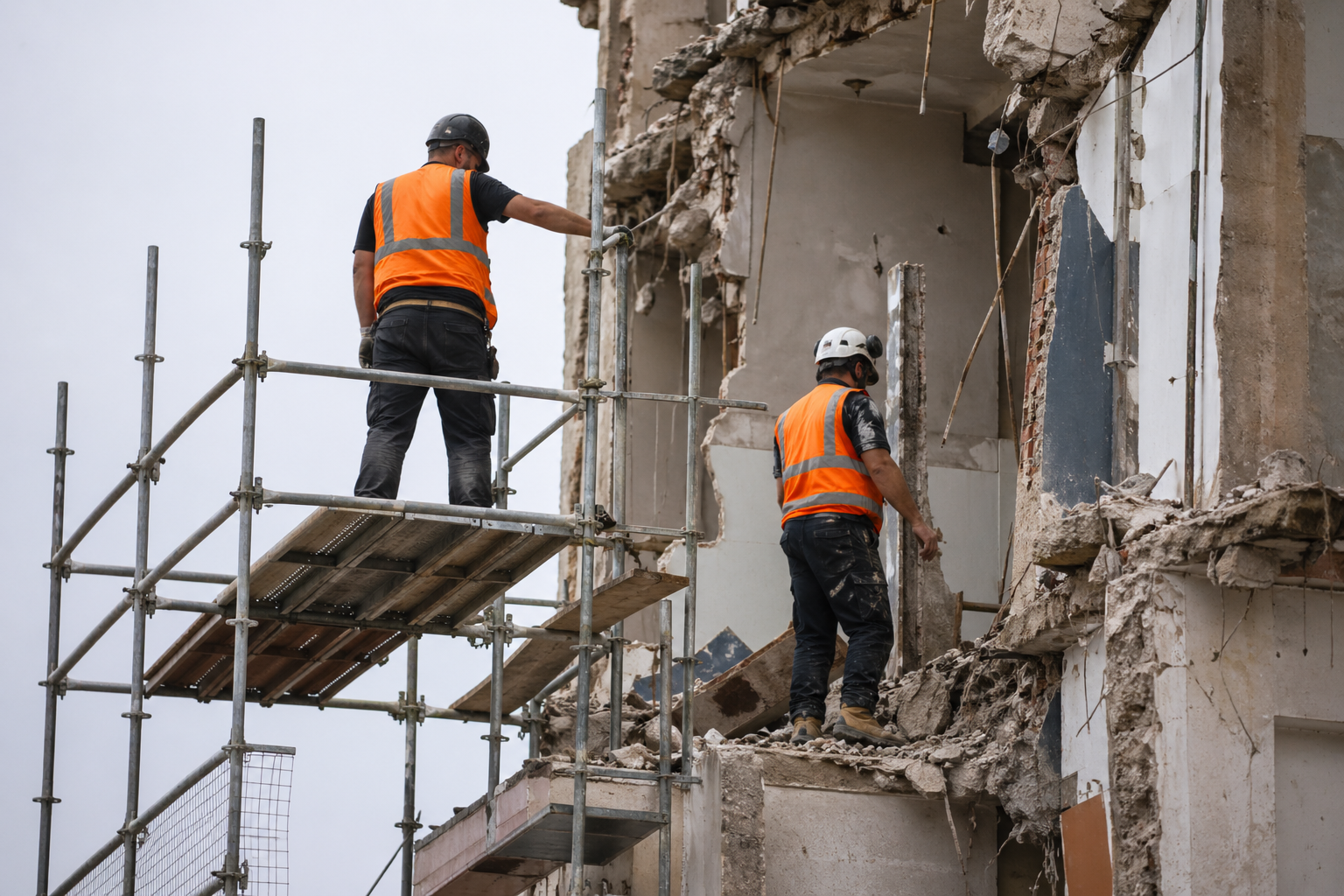
Demolition isn’t simply construction in reverse. Unlike building projects where safety measures are built in from the start, demolition involves dismantling structures that may be unstable or contain hidden dangers. Workers face constantly changing conditions – one moment a wall provides support, the next it’s gone. Open edges appear unexpectedly, materials become fragile with age, and debris creates new hazards.
The risks multiply when working at height. Platforms that seem secure can fail without warning. Access routes disappear as structures are removed. Heavy machinery operates close to workers, increasing the chance of falls. Every demolition project requires careful planning to anticipate these moving hazards.
UK Legal Framework for Demolition Safety and Falls from Height
UK law sets clear expectations for demolition safety. The Work at Height Regulations 2005 (WAHR) specifically addresses fall prevention, requiring proper planning and supervision. Regulation 3 states employers must ensure work at height is carried out safely by competent people.
The Health and Safety at Work etc. Act 1974 provides the foundation, making employers responsible for worker safety. The Construction (Design and Management) Regulations 2015 add specific demolition requirements. Regulation 19 demands demolition is planned to prevent danger, with falls being a key concern.
Penalties for breaches are severe. One company faced £800,000 fines after a fatal fall during demolition. The HSE actively investigates such incidents and won’t hesitate to prosecute when safety fails.
Conducting a Comprehensive Demolition Risk Assessment for Falls
A thorough risk assessment forms the backbone of demolition safety. The Management of Health and Safety at Work Regulations 1999 require employers to assess risks properly. For demolition, this means identifying hazards that could lead to falls and implementing controls.
Step 1: Identify the Hazards
- Structural Instability: Check for weak floors, roofs and walls that might collapse
- Unprotected Edges: Note all open sides, floor holes and newly exposed areas
- Fragile Surfaces: Flag old skylights, asbestos cement or other weak materials
- Access Routes: Assess how workers will reach high areas safely
- Equipment: Review all platforms, scaffolds and machinery for safety
Step 2: Identify Who Might Be Harmed and How
Consider everyone on site – workers, supervisors and visitors. Picture specific scenarios like someone falling through a fragile roof or tripping near an unguarded edge.
Step 3: Evaluate the Risks and Decide on Precautions
For each hazard, judge how likely falls are and how severe injuries could be. Apply the hierarchy of controls – eliminate risks first, use protection as a last resort.
Step 4: Record Your Findings and Implement Them
Document all hazards and controls clearly. Share this information through inductions and toolbox talks. Make sure safety measures are in place before work starts.
Step 5: Review and Update
Demolition sites change constantly. Revisit risk assessments whenever work methods alter or new dangers emerge. This keeps protections relevant as the job progresses.
Hierarchy of Control for Preventing Falls from Height
The Work at Height Regulations 2005 set a clear order for managing fall risks:
1. Avoid Work at Height Where Possible
Can demolition be done from the ground? Long-reach excavators or demolition robots might eliminate the need to work high up.
2. Prevent Falls Using Collective Protective Measures
When working at height is unavoidable, use protections that safeguard everyone:
- Scaffolding: Properly built platforms with guardrails (to BS EN 12811-1)
- MEWPs: Mobile platforms operated by trained staff
- Edge Protection: Strong barriers around openings (to BS EN 13374)
- Safety Nets: Installed below work areas (to BS EN 1263-1)
3. Minimise the Distance and Consequences of a Fall
When collective measures aren’t possible, use personal protection:
- Fall Restraint: Prevents workers reaching fall hazards
- Fall Arrest: Safely stops falls using harnesses and anchors
- Airbags: Cushion falls where other systems won’t work
4. Mitigating Remaining Risks
Even with controls, some risks remain. Manage these through:
- Clear emergency rescue plans
- Proper training for all workers
- Permit systems for high-risk tasks
Practical Checklist for Demolition Safety: Preventing Falls
Use this checklist to ensure key safety measures are in place:
Pre-Demolition Planning and Assessment:
- Complete structural survey by competent person
- Prepare written demolition method statement
- Conduct specific fall risk assessment
- Verify all staff are properly trained
- Establish emergency procedures
- Isolate all utilities safely
Control Measures Implementation:
- Install edge protection around all openings
- Mark and protect fragile surfaces
- Provide safe access routes
- Inspect all scaffolding before use
- Check MEWPs daily
- Fit safety nets where needed
- Issue personal fall protection if required
- Set up exclusion zones below work areas
Ongoing Monitoring and Review:
- Maintain competent supervision
- Hold regular toolbox talks
- Inspect equipment frequently
- Monitor weather conditions
- Update risk assessments as work progresses
Planning, Supervision, and Competence in Demolition
These three elements form the foundation of demolition safety:
Planning: The Blueprint for Safety
- Gather pre-construction information about the site
- Develop detailed demolition method statements
- Design temporary works properly
- Coordinate service disconnections
Supervision: The Eyes and Ears on Site
- Ensure competent supervision at all times
- Monitor compliance with safety measures
- Adapt to changing site conditions
- Communicate clearly with workers
Competence: The Foundation of Safe Work
- Verify all workers have appropriate training
- Check plant operator qualifications
- Train staff in fall protection use
- Conduct thorough site inductions
- Provide ongoing skills development
Conclusion: Upholding Safety in Demolition
Preventing falls during demolition requires constant vigilance. UK law sets high standards through the Health and Safety at Work etc. Act 1974, Work at Height Regulations 2005 and CDM 2015. Beyond legal duties, there’s a moral obligation to protect workers’ lives.
Success comes from thorough planning, robust risk assessments and proper training. Every demolition site needs a culture where safety comes first. Review your current practices against this guidance and visit www.hse.gov.uk for more information.
Frequently Asked Questions

What makes demolition work particularly dangerous for falls from height?
Demolition creates constantly changing hazards as structures are dismantled - stable surfaces become unstable, new edges appear unexpectedly, and materials degrade unpredictably. Unlike construction where safety measures are planned from the start, demolition workers face evolving risks that require dynamic risk assessments throughout the project.
What UK laws specifically address fall prevention in demolition work?
The Work at Height Regulations 2005 (WAHR) mandate safe systems for working at height, while the Construction (Design and Management) Regulations 2015 require specific demolition planning under Regulation 19. The Health and Safety at Work etc. Act 1974 establishes the fundamental duty for employers to ensure worker safety, including fall prevention measures.
Are written risk assessments legally required for demolition projects?
Yes, Regulation 3 of the Management of Health and Safety at Work Regulations 1999 requires written risk assessments for all demolition work. These must specifically address fall hazards and be updated as conditions change during the demolition process. HSE prosecutions have shown failure to maintain current risk assessments contributes to fatal accidents.
Who is responsible for ensuring safe working at height during demolition?
Employers bear ultimate responsibility under the Health and Safety at Work etc. Act 1974. The Work at Height Regulations 2005 further specify that only competent persons may plan or supervise work at height. This includes assessing structural stability, selecting appropriate equipment, and implementing fall prevention systems throughout the demolition process.
What penalties might companies face for fall-related incidents during demolition?
HSE prosecutions for falls during demolition have resulted in fines exceeding £800,000 in severe cases. Penalties consider the level of negligence, with higher fines when proper planning, equipment or training were lacking. Criminal charges can be brought against directors for serious breaches of health and safety law.
How often should demolition fall prevention measures be reviewed?
Risk assessments and control measures must be reviewed continuously as demolition progresses, as new hazards emerge when structures are partially dismantled. The Work at Height Regulations 2005 require supervisors to monitor changing conditions and adapt safety systems accordingly throughout the project duration.