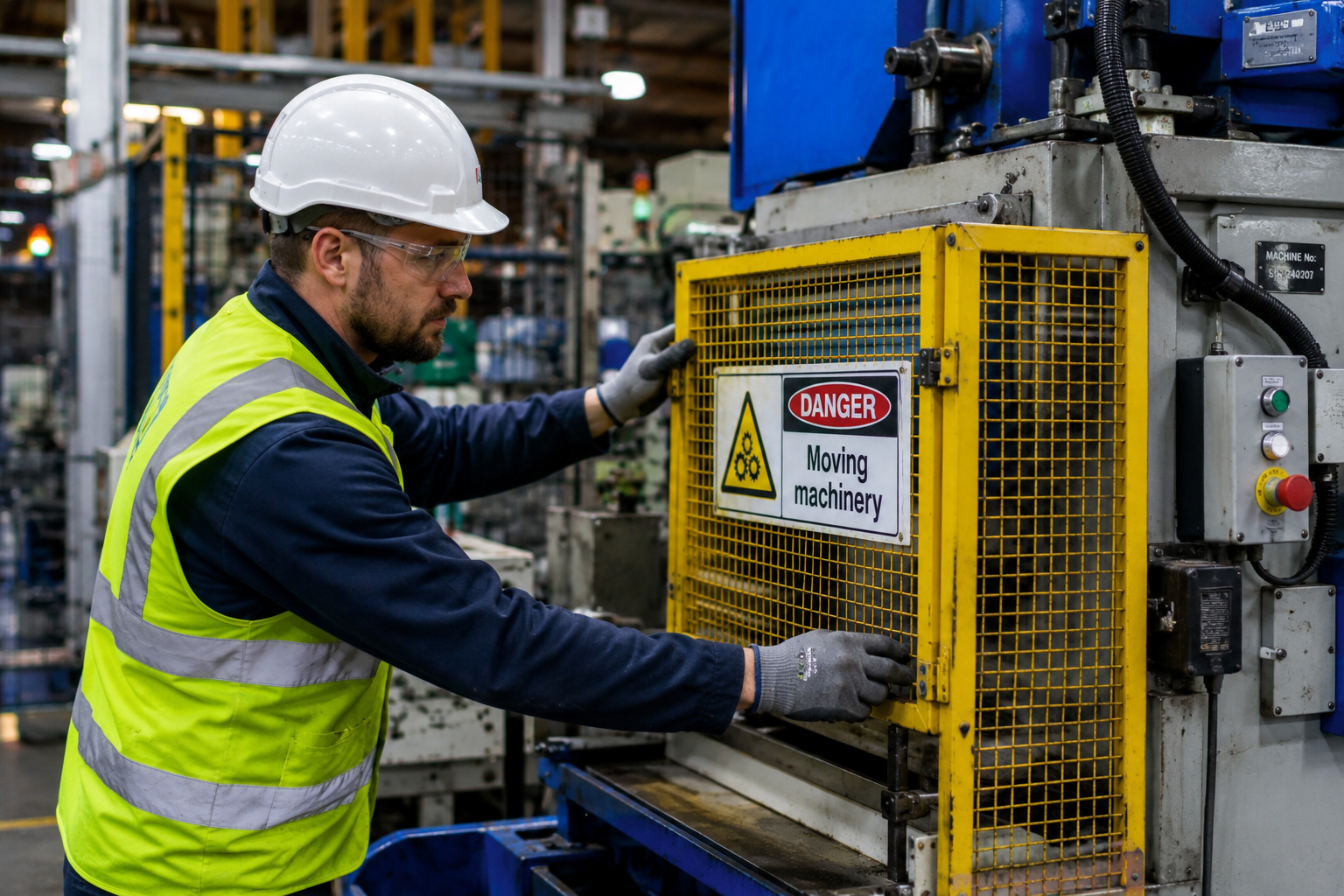
Machinery guarding failures continue to plague UK manufacturing, with devastating consequences. HSE statistics show contact with moving machinery remains a leading cause of workplace injuries, often resulting in life-changing amputations and crush injuries. One recent case saw a £120,000 fine after an employee’s hand became trapped in unguarded equipment. This wasn’t an isolated incident. It highlights why proper guarding matters and why compliance with PUWER 1998 isn’t optional.
The Persistent Problem of Inadequate Machinery Guarding
Despite clear regulations, inadequate guarding persists across UK factories. Some chase production speed. Others misunderstand risks. Many simply grow complacent. The results can be catastrophic in seconds – rotating shafts, gears and cutting tools deliver devastating force. Injuries often involve amputations or crushing, requiring extensive treatment and rehabilitation.
Older machinery poses particular risks. Original guards get removed or damaged. Newer equipment isn’t immune either – poor maintenance or training can undermine even the best designs. The HSE stresses most incidents are preventable through proper risk assessment and guarding solutions. With UK regulations aligning with EU standards from 2027, businesses must stay vigilant.
UK Legal Framework Governing Machinery Safety
UK law provides robust protections around machinery safety. The key legislation includes:
Health and Safety at Work etc. Act 1974 (HSWA)
Section 2(1) places a general duty on employers to protect workers’ health and safety. Section 3 extends this to non-employees. Breaches can bring unlimited fines and even imprisonment.
The Provision and Use of Work Equipment Regulations 1998 (PUWER)
PUWER forms the backbone of machinery safety law. Key requirements include:
- Regulation 11: Preventing access to dangerous machinery parts
- Regulation 12: Protection against ejected materials
- Regulation 14-17: Safe control systems and emergency stops
The accompanying L22 guidance explains how to comply. Breaches can lead to prosecution under HSWA.
The Supply of Machinery (Safety) Regulations 2008
These implement EU machinery safety standards in UK law. While mainly affecting manufacturers, employers must ensure purchased equipment meets these standards.
Management of Health and Safety at Work Regulations 1999
Requires risk assessments and proper safety management systems. Failing to assess machinery risks properly features in many HSE cases.
Penalties have teeth. Unlimited fines follow HSWA breaches, with possible jail time for individuals under Section 37.
Recent HSE Enforcement Actions: A Sobering Reminder
Recent cases show the consequences of guarding failures:
- A metal processor received a £120,000 fine after an employee lost a finger in unguarded machinery. The guard had been deliberately defeated with no system to prevent this. The company pleaded guilty to breaching PUWER Regulation 11(1).
- A packaging firm paid £80,000 when a worker’s arm got caught in conveyor nip points. The guarding was inadequate and easily bypassed.
- A woodworking company faced a £60,000 penalty after an employee suffered hand fractures clearing a jammed machine with bypassed interlocks.
Common themes emerge:
- Guards that are removed or bypassed
- Poor maintenance
- Defeated safety systems
- Insufficient risk assessments
- Lax training and supervision
Beyond fines, companies face production losses, legal costs and reputational damage.
Practical Checklist for PUWER Compliance and Effective Guarding
Follow this systematic approach to ensure machinery safety:
1. Comprehensive Risk Assessment
- List all machinery
- Identify dangerous parts and access routes
- Consider all operational phases
- Evaluate existing controls
- Prioritise risks
2. Appropriate Guarding Selection
Apply the hierarchy of control:
- Fixed guards for permanent protection
- Interlocked guards where access is needed
- Adjustable guards for variable operations
- Other devices like light curtains where suitable
3. Maintenance and Inspection
- Schedule regular guard inspections
- Establish defect reporting systems
- Use competent personnel
- Keep detailed records
4. Safe Systems of Work
- Develop clear operating procedures
- Implement robust lock-out/tag-out
- Use permits for high-risk work
5. Training and Information
- Provide machine-specific training
- Cover guard purpose and function
- Include emergency procedures
- Offer refresher courses
6. Monitoring and Review
- Conduct safety audits
- Investigate incidents thoroughly
- Update risk assessments regularly
Understanding Different Types of Guards and Safety Devices
Choosing the right protection requires understanding the options:
- Fixed Guards
Permanent barriers needing tools for removal. Ideal for areas requiring infrequent access. - Interlocked Guards
Connect to machine controls to prevent operation when open. Essential where regular access is needed. - Adjustable Guards
Allow for different workpiece sizes but require operator discipline to position correctly. - Self-Adjusting Guards
Automatically adapt to materials, reducing human error risks. - Pressure-Sensitive Mats/Edges
Stop machinery when presence is detected. Useful where traditional guards aren’t practical. - Light Curtains and Safety Scanners
Create invisible detection fields. Good for large or complex access areas. - Two-Hand Controls
Require simultaneous button presses, keeping hands clear of danger zones.
Often, combining several methods provides the best protection.
Training, Supervision, and Safe Systems of Work
Physical guards alone aren’t enough. Human factors matter just as much.
Comprehensive Training
Must cover:
- Specific machine hazards
- Guard purpose and operation
- Safe working procedures
- Defect reporting
- Lock-out/tag-out systems
Effective Supervision
Supervisors should:
- Monitor compliance
- Intervene on unsafe acts
- Lead by example
- Provide coaching
- Enforce rules consistently
Robust Safe Systems of Work
Include:
- Written procedures
- Permit-to-work for high-risk tasks
- Clear responsibilities
- Emergency plans
This three-pronged approach creates a safety culture where guards aren’t bypassed and risks are properly managed.
The Future of UK Machinery Safety and Employer Obligations
UK machinery safety rules will align with EU standards from 2027, maintaining CE marking for certain products. However, core employer duties remain unchanged:
- Provide safe equipment meeting UKCA/CE standards
- Maintain machinery properly
- Conduct thorough risk assessments
- Implement safe working systems
- Deliver comprehensive training
- Supervise effectively
Businesses should view regulatory changes as opportunities to enhance safety, not just compliance exercises.
Conclusion
Machinery guarding failures carry heavy costs – both human and financial. Recent HSE cases prove compliance with PUWER and HSWA isn’t optional. With regulatory changes coming, manufacturers must review their guarding arrangements now. Proper risk assessments, suitable guards, maintenance systems and training all play vital roles. The next step? Conduct a thorough guarding review across all equipment. It’s the only way to protect both workers and the business itself.
Frequently Asked Questions

What are the most common injuries from machinery guarding failures?
Contact with moving machinery often results in life-changing amputations and crush injuries, as highlighted by recent HSE cases. Rotating shafts, gears, and cutting tools can cause devastating damage in seconds, requiring extensive treatment and rehabilitation.
Can employers be fined for unguarded machinery?
Yes, the HSE regularly issues substantial fines for guarding failures, with one recent case resulting in a £120,000 penalty. Under PUWER 1998 and HSWA 1974, employers face unlimited fines and potential imprisonment for serious breaches.
Does older machinery pose greater guarding risks?
Older equipment presents particular dangers as original guards often get removed or damaged over time. However, the HSE notes that even newer machinery becomes hazardous if poorly maintained or if workers receive inadequate training.
What does PUWER Regulation 11 specifically require?
PUWER Regulation 11 mandates employers to prevent access to dangerous machinery parts through proper guarding. This aligns with the broader duty under HSWA 1974 to protect workers from moving machinery hazards.
How often should machinery guards be inspected?
While the article doesn't specify exact frequencies, the HSE emphasizes that guards require proper maintenance and that risk assessments should be reviewed whenever work conditions change significantly or after incidents occur.
Are UK machinery safety standards changing soon?
Yes, UK regulations will align with EU machinery safety standards from 2027, requiring businesses to stay vigilant about compliance. Current PUWER and HSWA requirements remain fully enforceable during this transition period.