On 1 October 2023, a fundamental change to UK fire safety law took effect with remarkably little fanfare — and over 60% of UK organisations still don’t know about it.
The amendment to Section 156 of the Regulatory Reform (Fire Safety) Order 2005 eliminated the five-employee threshold for written fire risk assessments, requiring all UK businesses to document their fire safety arrangements in writing — regardless of size.
Combined with the Fire Safety (England) Regulations 2022 (effective 23 January 2023) and the ongoing implementation of the Building Safety Act 2022, the UK fire safety compliance landscape has undergone its most significant transformation since the original Fire Safety Order in 2005.
For safety professionals, this represents both a compliance challenge and an opportunity to elevate fire safety standards across their organisations. This guide provides evidence-based guidance on navigating these legislative changes, identifying compliance gaps, and implementing robust fire safety management systems.
Why October 2023 Changed Everything
The Section 156 amendments fundamentally altered fire safety compliance obligations in three critical ways:
1. Universal Documentation is Now Mandatory
Sole traders, micro-businesses, small offices, and organisations with fewer than five employees now face the same written assessment obligations as large corporations. A single-person consultancy operating from serviced offices must maintain the same quality of documented fire risk assessment as a multinational manufacturer.
2. No More Ambiguity on Standards
Previously, some small businesses argued that mental assessments or informal notes satisfied their obligations. The amended legislation is explicit: a “suitable and sufficient” fire risk assessment must be recorded in writing and be available for inspection by enforcement authorities.
3. Heightened HSE Enforcement Activity
The amendment coincided with significantly increased enforcement. HSE prosecution data from 2023–2025 shows:
- A 34% increase in fire safety-related enforcement notices compared to 2020–2022
- Documentation inadequacies cited in 78% of cases
- Average fine for fire safety breaches rose to £47,000 in 2024, with some cases exceeding £200,000
Fire Safety (England) Regulations 2022: What’s New
Effective from 23 January 2023, these regulations introduced new obligations particularly impacting multi-occupied premises and buildings with residential elements.
Enhanced Cooperation Between Responsible Persons
In buildings where multiple businesses operate — shopping centres, business parks, office towers — each Responsible Person must now cooperate and coordinate with others. This means:
- Sharing fire risk assessment findings relevant to shared areas or adjoining premises
- Coordinating fire evacuation procedures and drills across all occupiers
- Establishing clear responsibilities for fire safety in common areas (corridors, stairwells, car parks)
- Documenting cooperation arrangements and communication protocols
Practical example: A safety manager in a three-storey office building with six different businesses must establish formal cooperation arrangements with each tenant’s Responsible Person, coordinate quarterly fire drills, and maintain shared documentation of fire safety measures in communal spaces.
Electronic Reporting to Fire and Rescue Services
Buildings containing residential premises must now provide specific information to their local Fire and Rescue Service, including:
- Floor plans showing escape routes and fire safety equipment locations
- Details of external wall construction and materials (particularly relevant post-Grenfell)
- Information about residents who may require assistance during evacuation
- Secure information boxes containing building plans and emergency contact details
Wayfinding Signage and Building Information
The regulations mandate improved wayfinding signage in buildings containing flats, helping firefighters navigate complex buildings during emergency response — including floor identification signage, flat numbering systems, and emergency access information.
Fire Safety Act 2021: Expanded Assessment Scope
Commenced in May 2022, the Fire Safety Act 2021 expanded the scope of fire risk assessments to explicitly include:
External Walls, Cladding, and Balconies
Following the Grenfell Tower tragedy, fire risk assessments must now address:
- External wall construction and materials (ACM cladding, HPL panels, render systems)
- Balcony construction, materials, and potential fire spread pathways
- Windows and their potential to compromise compartmentation
- Combustible materials attached to or forming part of external walls
For buildings over 11 metres in height, this often requires specialist assessment by fire safety engineers with expertise in external fire spread modelling.
Flat Entrance Doors in Multi-Occupied Buildings
Fire risk assessments in buildings containing flats must now evaluate door fire resistance (typically FD30S standard), door closer functionality, frame and seal integrity, and gaps that could compromise compartmentation.
Inspection frequencies are now legally specified:
- Quarterly: Fire door inspections in communal areas (corridors, stairwells)
- Annual: Checks of individual flat entrance doors
A Practical Five-Step Fire Risk Assessment Framework
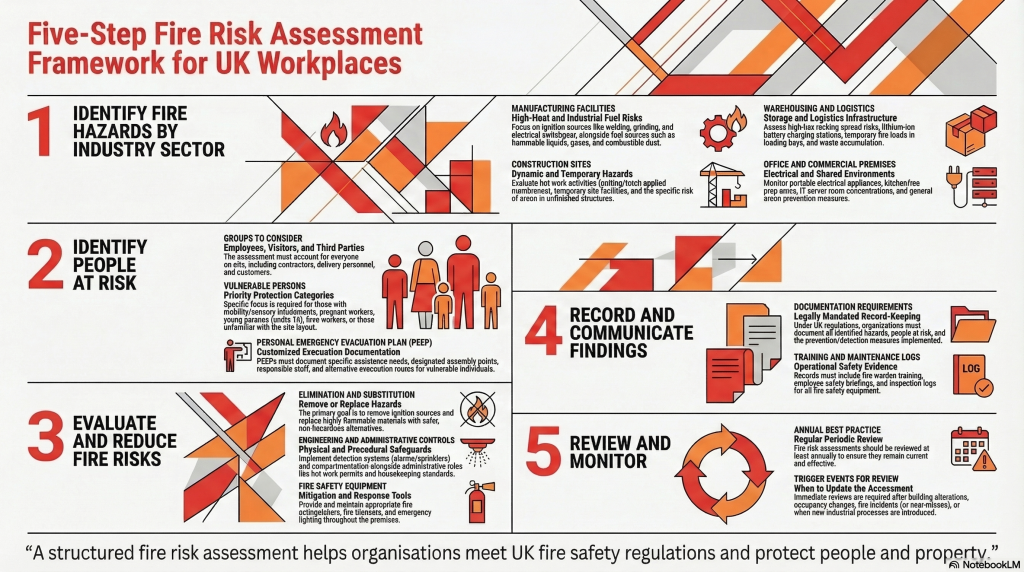
Step 1: Identify Fire Hazards by Industry Sector
Manufacturing Facilities
- Ignition sources: welding operations, grinding equipment, electrical switchgear, heat treatment processes
- Fuel sources: flammable liquids and gases, combustible dust, raw materials and finished goods storage
- Process-specific hazards: hot work permits, contractor management, maintenance activities
Warehousing and Logistics
- High-bay racking configurations affecting fire spread and sprinkler effectiveness
- Lithium-ion battery storage and electric vehicle charging infrastructure
- Goods-in/goods-out activities introducing temporary fire loads
- Waste accumulation and segregation practices
Construction Sites
- Temporary site facilities and changing fire risks as construction progresses
- Hot work activities (welding, cutting, torch-applied membranes)
- Contractor coordination and permit-to-work systems
- Arson prevention in unoccupied or partially completed structures
Office and Commercial Premises
- Electrical equipment and portable appliance management
- Kitchen and tea preparation areas
- Server rooms and IT equipment concentrations
- Arson prevention measures
Step 2: Identify People at Risk
The Fire Safety Order requires assessment of all persons potentially affected by fire, including employees, visitors, customers, contractors, and delivery personnel. Special consideration must be given to:
- Individuals with mobility, sensory, or cognitive impairments
- Pregnant workers
- Young persons (under 18)
- Lone workers and night shift personnel
- People unfamiliar with the premises
For each vulnerable person identified, a Personal Emergency Evacuation Plan (PEEP) should be created, documenting specific needs, assistance required, designated assembly points, named staff responsible, and alternative evacuation routes.
Step 3: Evaluate, Remove, or Reduce Risks
Apply the hierarchy of fire safety controls:
- Elimination — Remove ignition sources or combustible materials where possible
- Substitution — Replace highly flammable materials with less hazardous alternatives
- Engineering controls — Install fire detection systems, sprinklers, compartmentation
- Administrative controls — Implement hot work permits, no-smoking policies, housekeeping standards
- Fire safety equipment — Provide appropriate extinguishers, blankets, and emergency lighting
Step 4: Record, Document, and Communicate
Under the amended Section 156, ALL organisations must document:
- Significant fire hazards identified
- People especially at risk
- Fire safety measures implemented (prevention, detection, evacuation, firefighting)
- Findings and actions arising from the assessment
- Emergency evacuation procedures
- Training provided to employees and fire wardens
- Inspection and maintenance records for fire safety equipment
Step 5: Review and Monitor
Fire risk assessments must be reviewed:
- At least annually as best practice
- Following any significant changes (building alterations, change of use, occupancy changes)
- After fire incidents, near-misses, or false alarms
- When new equipment or processes are introduced
- Following changes to neighbouring premises
Common Compliance Failures: Lessons from HSE Enforcement

Analysis of HSE enforcement actions from 2023–2025 reveals three recurring failure types:
Inadequate Documentation (78% of enforcement notices)
Generic template assessments, unfilled blanks, no building-specific hazards, missing PEEPs, and no evidence of review are among the most cited deficiencies.
Case study: A retail business received a £52,000 fine after an HSE inspector found their fire risk assessment was a two-page generic template — purchased online with blanks unfilled — making no reference to the building’s actual layout, identifying no specific hazards, and containing no emergency procedures.
Fire Warden Training Gaps (64% of cases)
Common failures include no documented appointments, training not refreshed annually, fire wardens unaware of responsibilities, and no cover arrangements for absences.
Case study: A manufacturing facility faced prosecution after a small fire escalated because the on-duty fire warden had never received practical training on extinguishers and did not know the location of fire alarm call points.
Coordination Failures in Multi-Occupied Buildings (71% of relevant premises)
Conflicting evacuation procedures, no cooperation arrangements, and unclear responsibilities for common areas are frequently cited.
Case study: A three-storey business park received an enforcement notice after inspectors discovered three occupiers had different evacuation procedures, no one had assessed the shared stairwell and car park, and no coordinated drill had ever been conducted.
Your Implementation Action Plan
Immediate Actions (This Week)
- Verify written fire risk assessments exist for all sites — including single-person offices, storage units, and temporary locations
- Check assessment dates and confirm they address external walls, flat entrance doors (if applicable), and people at risk
- Confirm fire wardens are appointed for each shift/area with current training
- Test fire alarm activation, emergency lighting, extinguisher access, and evacuation route signage
30-Day Implementation Plan
- Conduct a full gap analysis against the Fire Safety Act 2021, Fire Safety (England) Regulations 2022, and Section 156 requirements
- Update fire risk assessments to include external walls, cladding, balconies, and enhanced cooperation documentation
- Create or update PEEPs for all vulnerable persons
- Appoint sufficient fire wardens (recommended: 1 per 20–30 employees) and schedule training
- Establish cooperation agreements and coordinated drill schedules with other Responsible Persons in shared buildings
Ongoing Compliance Calendar
Quarterly:
- Fire door inspections (communal areas in residential buildings)
- Fire warden team meetings and competency checks
- Fire safety equipment visual inspections
- Review of fire incident logs, near-misses, and false alarms
Annually:
- Full fire risk assessment review and update
- Flat entrance door inspections (residential buildings)
- Professional servicing of fire alarm, suppression systems, and emergency lighting
- Fire extinguisher annual servicing
- Staff fire safety refresher training
- Fire evacuation drill (minimum one annually; best practice is twice annually)
- Review of fire safety KPIs and compliance metrics
From Compliance to Competence
The 2023 fire safety regulatory changes represent more than a compliance exercise. They offer safety professionals an opportunity to elevate fire safety from a checkbox activity to a core component of organisational risk management.
The question is no longer whether your organisation complies with fire safety law — but whether your fire safety arrangements would withstand scrutiny during an HSE inspection, protect your people during an actual emergency, and demonstrate the duty of care expected of a competent safety professional.
Start today: audit your current arrangements, identify gaps, and establish systems that ensure ongoing compliance. The regulatory landscape has changed — your fire safety programme must change with it.